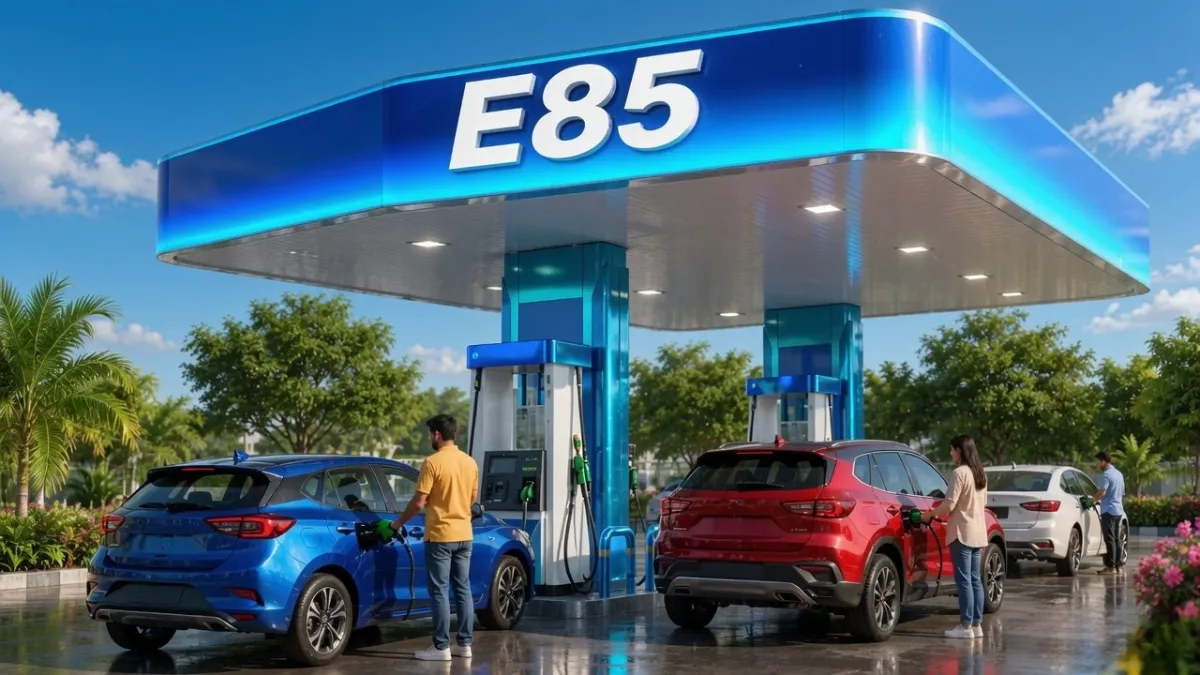
E85 fuel has officially arrived in India, and it is already making headlines. Launched in Delhi at just Rs. 82.12 per litre, this new fuel is significantly cheaper than regular petrol, which currently costs around Rs. 110 per litre in Mumbai. But before you get too excited, there is one very important question you need to answer first — can your car actually use it?
What Is E85 Fuel and Why Is It Different?
E85 is not simply another version of petrol. The E85 fuel blend contains up to 85 per cent ethanol and just 15 per cent petrol. This is a massive step up from the E20 fuel currently available across India, which contains only 20 per cent ethanol.
Because of this high ethanol concentration, E85 requires specially designed engines and fuel systems that can handle the unique chemical properties of ethanol. This is why the E85 fuel launched in Delhi is such a significant moment — it marks a new chapter in India’s ethanol-blending programme, but one that comes with important limitations for most car owners.
E85 Fuel News — What Has Been Announced
The latest E85 fuel news confirms that the fuel has been introduced in Delhi as part of India’s broader push to reduce crude oil imports and support domestic ethanol production. Priced at Rs. 82.12 per litre, it appears nearly Rs. 28 cheaper than petrol at first glance. However, as you will see below, the per-litre price alone does not tell the full story.
Can Your Car Use E85? — E85 Car Compatibility Explained
This is the most important question for any Indian motorist. The short answer is: most cars currently on Indian roads cannot run on E85.
Even vehicles that have been upgraded to support E20 petrol are not automatically compatible with E85. Running E85 in a conventional petrol engine could lead to serious performance issues and long-term mechanical damage.
To use E85, a vehicle must be flex-fuel compatible. A flex-fuel E85 car can automatically adjust its engine parameters to run on any ethanol blend — from regular petrol all the way up to E85. These vehicles have specially built fuel systems, sensors, and engine management software designed to handle varying ethanol concentrations without any damage.
Flex-Fuel Vehicles in India — Where Things Stand
Over the past few years, several manufacturers have showcased flex-fuel prototypes in India. One of the most talked-about examples is the Maruti Suzuki Wagon R Flex Fuel, which was specifically developed to operate on higher ethanol blends including E85.
However, E85 fuel cars in India that are commercially available remain extremely rare at this point. Until flex-fuel vehicles become more widely available in the Indian market, E85 will remain out of reach for the majority of car owners — regardless of how attractive the price looks.
Will E85 Actually Save You Money?
This is where things get more complicated. At Rs. 82.12 per litre, E85 is around 20 per cent cheaper than petrol in Delhi. On paper, this should translate into lower running costs. But the reality is quite different.
Ethanol contains less energy per litre than petrol. As a result, vehicles running on E85 generally consume more fuel to travel the same distance. In international markets like Brazil and the United States, flex-fuel vehicles operating on E85 often experience a fuel efficiency drop of anywhere between 20 and 30 per cent compared to petrol.
Here is a simple example to understand this better:
| Fuel Type | Fuel Price | Fuel Efficiency | Running Cost Per km |
|---|---|---|---|
| Regular Petrol | Rs. 102.12/litre | 15 kmpl | Rs. 6.81/km |
| E85 (25% efficiency drop) | Rs. 82.12/litre | 11.25 kmpl | Rs. 7.30/km |
As the table clearly shows, despite the lower per-litre price of E85, the actual running cost per kilometre turns out to be higher due to reduced fuel efficiency. This is a critical point that every motorist should understand before assuming E85 will reduce their fuel bills.
E85 Near Me — Where Can You Find It?
If you are searching for E85 near me in India, availability is currently very limited. At the moment, E85 is only available at select fuel stations in Delhi. There is no widespread rollout yet, and until the government expands the distribution network alongside a larger fleet of compatible flex-fuel vehicles, finding an E85 pump near you will remain a challenge for most people across the country.
What About E85 BMW and Other Premium Cars?
Internationally, high-performance cars often run on E85 because ethanol has a higher octane rating, which can help increase engine power under the right conditions. E85 BMW tuning is a well-known practice in European and American motorsport and performance car communities, where enthusiasts use E85 to extract more power from turbocharged engines.
However, in the Indian context, this is not yet a realistic option for most drivers. Even premium vehicles sold in India are not officially flex-fuel compatible, and using E85 in a standard petrol engine — no matter the brand — risks damaging the fuel system and engine components.
E85 India — The Bigger Picture
The launch of E85 in India is not primarily about saving money at the pump. It is part of a much larger national strategy that aims to:
- Reduce India’s dependence on imported crude oil
- Support domestic ethanol production from agricultural feedstocks like sugarcane and maize
- Lower tailpipe emissions and improve air quality
- Strengthen the rural agricultural economy by creating demand for ethanol crops
Ethanol is a domestically produced fuel, which means greater use of E85 could reduce the foreign exchange India spends on oil imports every year. From a national and environmental perspective, this is the real value of the E85 programme.
Should You Switch to E85?
Here is a quick summary to help you decide:
- ✅ Your car is flex-fuel compatible → E85 is worth exploring
- ❌ Your car runs on regular petrol or E20 → Do not use E85, it can damage your engine
- ✅ You want to support cleaner, domestic fuel → E85 aligns with that goal
- ❌ You are hoping to save money immediately → The mileage drop may cancel out the price benefit
Frequently Asked Questions
Q: Can I use E85 in my normal petrol car?
A: No. Unless your vehicle is specifically labeled as a “Flex-Fuel” vehicle, using E85 can damage your fuel lines, injectors, and engine.
Q: Where can I find E85 near me?
A: Currently, E85 stations are being launched in major metro cities like Delhi as part of a pilot project. You can check the latest E85 fuel news for updated station lists.
Q: Is there an E85 song or cultural trend?
A: While there is an E85 song popular in automotive subcultures abroad (often referencing high-performance tuning), in India, the focus remains strictly on its role as a sustainable fuel alternative.
Q: Will using E85 reduce my car’s emissions?
A: Yes, ethanol is a cleaner-burning fuel than petrol, meaning a car running on E85 typically produces fewer harmful tailpipe emissions.
Final Words
The arrival of E85 fuel in India is a genuinely exciting step forward for the country’s energy transition. But for most car owners today, it remains more of a technology showcase than a practical daily-use fuel. E85 fuel cars in India are still rare, availability is limited, and the fuel efficiency trade-off means the savings are not as straightforward as the price tag suggests.
As flex-fuel vehicles become more widely available and E85 pumps expand across the country, this could change significantly. For now, keep an eye on the E85 fuel news, check whether your vehicle is compatible, and watch this space — because India’s ethanol journey is only just getting started. ⛽