
The Tata Aeris is the latest compact sedan from Tata Motors and effectively takes over from the Tigor in the private-car market. While the name is new, the underlying mechanical package is familiar, with the sedan continuing with a 1.2-litre three-cylinder naturally aspirated petrol engine and factory-fitted CNG technology.
What makes the Aeris more interesting than its predecessor is the substantial styling update, a significantly more modern cabin and a much longer equipment list. Tata has also retained both manual and AMT transmissions across the petrol and CNG range, making the car available to buyers looking for either driving involvement or greater convenience in traffic.
After driving both versions, the biggest question is whether the new design and additional features are enough to make the Aeris a stronger alternative to cars such as the Maruti Dzire, Hyundai Aura and Honda Amaze.
Tata Aeris Petrol and CNG Price
The Tata Aeris price in India starts at ₹5.29 lakh and goes up to around ₹9.74 lakh for the top-spec CNG AMT variant, with prices quoted ex-showroom Delhi at launch.
The petrol range starts at ₹5.29 lakh, while CNG versions start from ₹6.29 lakh. Both fuel types are available with a 5-speed manual, while AMT is offered on selected higher variants.
The Aeris is also positioned as a private-buyer-focused model, while Tata will continue offering the Xpres range for fleet customers.

Tata Aeris Design: A Major Step Up From the Tigor
The biggest change becomes obvious before you even get inside.
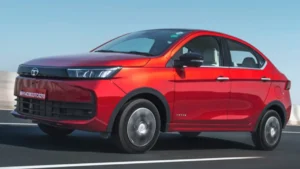
The Tata Aeris retains the basic compact-sedan silhouette of the Tigor, but Tata has extensively redesigned the exterior. The front gets a blacked-out grille and a wider-looking lower section that gives the sedan a more planted appearance.
The new lighting elements and sharper surfacing make the Aeris look considerably more modern than the outgoing Tigor.
At the rear, Tata has also made changes to the boot mechanism. The revised arrangement allows the boot area to be better packaged while maintaining the sedan’s practical character.
Overall, the Aeris looks more mature and sophisticated rather than trying to imitate an SUV.
Tata Aeris Interior and Features
The cabin is another area where Tata has made a significant improvement.
The Tata Aeris interior gets a completely refreshed dashboard layout, a new steering wheel and a more premium-looking cabin compared with the Tigor.
Higher variants can be equipped with features such as a 360-degree camera with blind-view monitoring, ventilated front seats, wireless smartphone connectivity, automatic climate control, rear AC vents and a centre armrest.
This makes the Aeris one of the more feature-rich options in the compact sedan category.
The seats are comfortable overall, although thigh support could be better for taller occupants. The ventilated-seat function is particularly useful in India’s hot climate, although the system itself can be somewhat noisy.
Tata Aeris Petrol Performance
The petrol version uses a 1.2-litre three-cylinder naturally aspirated engine producing 86hp and 113Nm.
The petrol engine has a noticeable advantage over the CNG version because of its additional output. Around town, the Aeris feels sufficiently responsive and is easy to drive in normal traffic.
The engine is not particularly refined, however. Vibrations can be felt at idle and at low speeds, while the engine becomes noticeably coarse when pushed beyond the mid-range. Cabin insulation is also an area where Tata could have done better.
For normal urban driving, the performance is adequate. On the highway, the petrol Aeris has enough ability to maintain cruising speeds and is more comfortable during overtaking than the CNG version.
Tata Aeris Manual Gearbox Review
The 5-speed manual gearbox is one of the better aspects of the driving experience.
The gear lever has relatively short throws and clearly defined gates. The clutch is also light, which makes the car easy to operate in heavy traffic.
The manual version offers better control during highway driving, particularly when overtaking, because the driver can select the appropriate gear instead of waiting for the AMT to respond.
For buyers who frequently travel outside the city, the petrol-manual combination is arguably the most satisfying configuration of the Aeris range.
Tata Aeris AMT Performance
The 5-speed AMT is aimed primarily at buyers who spend significant time in urban traffic.
It offers a useful creep function and makes stop-and-go driving considerably easier. With gentle throttle inputs, the gearbox behaves reasonably well.
However, aggressive acceleration exposes the typical hesitation associated with an AMT. Sudden overtakes therefore require some planning, particularly on highways.
For city-focused buyers, the convenience of two-pedal driving makes the AMT a worthwhile option. Enthusiastic drivers, however, will likely prefer the manual.
Tata Aeris CNG Performance
The CNG version uses the same 1.2-litre three-cylinder engine but produces approximately 74–76hp and 96.5–97Nm, depending on the specification cited.
The CNG system can start the vehicle directly in CNG mode when sufficient gas is available, and the driver can switch between petrol and CNG while driving.
Performance is adequate for city use, but the lower output is noticeable when compared with the petrol model. The engine also becomes noisier and more vibratory in CNG mode.
The Aeris CNG is therefore better suited to buyers who prioritise running costs over outright performance.
Tata Aeris CNG Real-World Mileage
One of the strongest reasons to consider the CNG version is its real-world efficiency.
During a mixed driving test covering 138km, including city traffic, larger urban roads and multi-lane highways, the Aeris CNG consumed around 5.38kg of gas.
This worked out to approximately 25.6km/kg in real-world conditions, which is a strong result for a compact sedan with an AMT-equipped CNG powertrain.
The claimed efficiency is higher, with published figures around 26.49km/kg for the CNG manual and 28.06km/kg for the CNG automatic. Actual mileage will naturally depend on traffic, driving style, air-conditioning use and road conditions.
Ride and Handling
The Tata Aeris ride quality is one of its stronger characteristics.
The suspension deals well with broken urban roads, speed breakers and undulations. The sedan also maintains a composed attitude when travelling over uneven surfaces.
The steering gains weight as speed increases, which provides a reassuring feel on highways. Even when travelling over bumps at higher speeds, the Aeris remains relatively stable.
Its suspension setup is therefore well suited to Indian road conditions, particularly for buyers who regularly encounter poor-quality roads.
Tata Aeris CNG AMT: Does It Make Sense?
The combination of CNG and AMT is arguably one of the Aeris’ biggest selling points.
Traditionally, buyers choosing CNG had to accept a manual gearbox. The Aeris removes that compromise by offering automated manual transmission technology with its factory-fitted CNG system.
That means urban buyers can get the lower running costs of CNG without having to operate a clutch pedal in traffic.
The trade-off is performance. The three-cylinder engine feels strained when pushed hard, and vibrations are more noticeable in CNG operation. But for relaxed city driving, the combination works surprisingly well.
Tata Aeris Boot Space and Practicality
The Aeris retains the fundamental advantage of a sedan: a separate boot.
The revised boot mechanism also helps Tata make better use of the available space. The sedan offers around 419 litres of boot capacity, giving it useful luggage-carrying ability for everyday family use.
The CNG version uses Tata’s dual-cylinder CNG packaging, which helps preserve usable luggage space compared with older single-cylinder layouts.
This makes the Aeris more practical than many buyers might expect from an entry-level compact sedan.
Tata Aeris Safety and Equipment
Tata has also loaded the Aeris with a substantial amount of safety equipment on higher variants.
Depending on the variant, equipment includes electronic stability control, hill-hold assist, tyre-pressure monitoring, rain-sensing wipers, a dashcam and a 360-degree camera with blind-view monitoring.
The availability of these features gives the Aeris a strong equipment advantage in the segment.
However, the first-drive experience also highlighted some quality-related concerns, including inconsistent panel gaps and occasional camera performance issues.
Tata Aeris vs Maruti Dzire
The Maruti Dzire remains one of the biggest challenges for the Aeris.
The Dzire offers stronger claimed fuel-efficiency figures, particularly with its CNG powertrain, while the Aeris counters with a distinctive design, a strong feature list and Tata’s CNG AMT technology.
The Aeris is also priced aggressively, starting below the Dzire, giving Tata an opportunity to attract buyers who want a more affordable compact sedan with plenty of equipment.
Tata Aeris vs Hyundai Aura and Honda Amaze
The Hyundai Aura remains another direct competitor, particularly for buyers seeking a compact sedan with a comfortable city-oriented character.
The Honda Amaze, meanwhile, has traditionally appealed to buyers looking for a spacious cabin and refined petrol performance.
The Aeris differentiates itself through its feature list, CNG availability and distinctive styling. Its biggest weakness compared with some rivals is engine refinement.
Is Tata Aeris Petrol Better Than CNG?
For buyers who prioritise performance, highway driving and smoother overtaking, the Tata Aeris petrol is the better choice.
The 86hp petrol engine is still not exceptionally refined, but it has noticeably more flexibility than the CNG version.
The CNG model makes more sense for customers who drive long distances every month and want to reduce fuel expenditure. Its real-world efficiency is impressive, and the availability of an AMT makes it particularly attractive for city users.
Therefore, the choice largely depends on the buyer’s priorities rather than one version being universally better.
Market Positioning
The Tata Aeris enters the compact sedan market with a much stronger proposition than the Tigor it replaces. Its sharper exterior, modernised cabin, extensive equipment list and petrol/CNG flexibility give it several advantages.
The CNG AMT combination is particularly significant because it gives buyers an easy-to-drive, factory-fitted CNG sedan without sacrificing the convenience of an automatic-style transmission.
Its biggest drawbacks remain engine refinement, cabin insulation and some quality niggles. For buyers who can live with those compromises, the Aeris offers a compelling blend of affordability, practicality and features.
AutoXRoom Verdict
The Tata Aeris first drive review shows that Tata has focused on improving almost everything customers can see and interact with while retaining the proven mechanical package underneath.
The petrol version is the better all-rounder for buyers who want stronger performance, while the CNG version stands out for its running-cost advantage. The CNG AMT combination is arguably the Aeris’ biggest selling point, especially for people who spend most of their time in city traffic.
With prices starting at ₹5.29 lakh and a strong equipment list on higher variants, the Aeris has the potential to become a serious alternative to the Maruti Dzire, Hyundai Aura and Honda Amaze. Its success will ultimately depend on whether Tata can address refinement and quality concerns while maintaining its aggressive pricing.